
May 14, 2026
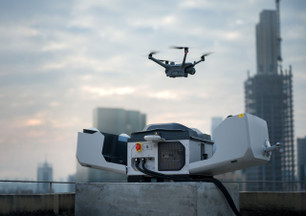
Dock-in-a-Box: Why the DJI Dock 3 is the End of the "Man in a Van" for UK Security
Watching a security guard shiver in a van during a February downpour in the Midlands is a stark reminder of the limitations of manual patrols. For years, the industry has looked for a way to provide 24/7 eyes-on-target without the logistical nightmare of rotating shifts and health and safety risks in remote environments. The DJI Dock 3, paired with the Matrice 4D series, finally moves the needle from "experimental" to "operational" for UK site security and infrastructure monitoring
Built for the British Climate: IP56 and Beyond
Operating remote hardware in the UK requires more than just a waterproof sticker; it demands true environmental sealing. The DJI Dock 3 features an IP56 ingress protection rating, meaning it is built to withstand high-pressure water jets and heavy dust
Inside the dock, an integrated climate control system manages the internal temperature to ensure the Matrice 4D’s batteries remain in the optimal charging window
The Matrice 4D: A Precision Tool for Remote Eyes
The aircraft living inside this dock, the Matrice 4D, is a compact powerhouse designed specifically for these high-readiness roles
-
Flight Endurance: The Matrice 4D series provides consistent flight times that allow for comprehensive perimeter checks of large industrial assets
. -
All-Weather Performance: Matching the dock, the aircraft itself features an IP55 rating, ensuring it can complete a mission in the drizzle that would ground a standard consumer drone
. -
High-Gain Transmission: Using the O4 Enterprise Enhanced system, the Dock 3 maintains a rock-solid link with the aircraft, even when navigating around heavy steel structures or in high-interference zones
.
Remote Operations and the Regulatory Hurdle
Flying a drone from an office 100 miles away sounds like the future, but in the UK, it brings immediate CAA scrutiny. Moving into Beyond Visual Line of Sight (BVLOS) operations requires a robust safety case and strict adherence to CAP 722. The DJI Dock 3 simplifies this by integrating with FlightHub 2, allowing for cloud-based mission planning and real-time monitoring
However, the hardware only solves half the problem. You still need to prove to the CAA that your remote operations are managed with the same—or greater—rigour than a traditional flight
Compliance at Scale with Dronedesk
Running an autonomous dock doesn't exempt you from the administrative responsibilities of a GVC holder. In fact, the CAA often expects more detailed record-keeping for remote deployments. Dronedesk serves as your central command centre for this data, bridging the gap between autonomous flight and regulatory compliance.
Whether you are managing a single dock at a warehouse or a dozen units across a national utility network, you need to track airframe hours, battery health, and pilot currency. Dronedesk allows you to keep extensive, audit-ready records that demonstrate a proactive approach to safety. When the CAA comes calling for a spot check on your remote operations, you can pull up a complete history of every risk assessment, flight log, and maintenance event with a few clicks.
ROI: Replacing the "Man in a Van"
The financial argument for the Dock 3 is simple: it is a fixed cost that provides infinite readiness. A traditional security patrol involves vehicle fuel, insurance, and the high cost of manual labour. A drone-in-a-box solution provides a much faster "first-to-scene" time for alarm triggers, often capturing high-resolution evidence before a ground team could even leave the gate.
For UK enterprises, the ability to conduct scheduled, autonomous inspections of critical infrastructure—like checking for thermal hotspots on a transformer or structural issues on a fence line—means maintenance issues are caught before they become expensive failures. The Dock 3 is not just a security tool; it is a full-time, remote site manager
Ready to Remote?
The DJI Dock 3 represents a fundamental shift in how we think about drone utility in the UK. We are moving away from drones being a "specialist tool" brought out for a day, and toward them being a permanent part of a site's infrastructure
If you are ready to explore how autonomous remote operations can reduce your site risks and operational costs, we are here to help. From initial safety case advice to hardware supply and setup, let's get your first dock deployed.