
Mar 17, 2026
The Future of Remote Ops: DJI Dock 3 vs DJI Dock 2 head-to-head
If you have spent any time managing a "drone-in-a-box" programme, you know the DJI Dock 2 was a massive step for rapid deployment. It was small enough to carry and reliable enough for routine mapping.
But the DJI Dock 3 isn't just an iteration. It is a fundamental shift from "stationary robot" to "tactical mobile asset."
We have stripped away the marketing fluff to look at exactly what has changed and why it matters for your ROI on-site.
True Mobility: The Vehicle-Mounted Revolution
The biggest limitation of the Dock 2 was its reliance on a concrete pad. It was designed to stay put.
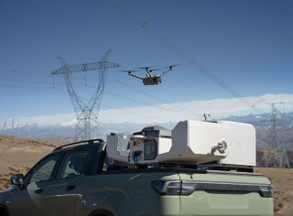
The DJI Dock 3 is the first system purpose-built for vehicle-mounted deployment. It features built-in anti-vibration systems and a modular internal layout that can handle the bumps of a construction trailer or a utility truck.
-
Dual-Dock Setup: You can now mount two Dock 3 units on a single vehicle. This allows for dual-drone rotation, meaning one bird is always in the air while the other is fast-charging.
-
Rapid Turnaround: While Dock 2 was fast, Dock 3 features updated takeoff logic that skips the propeller check. You can get the bird in the air in about 10 seconds.
Weather Resilience: IP56 and Beyond
British weather is the primary enemy of autonomous flight. The Dock 2 was hardy with an IP55 rating, but Dock 3 pushes this further.
With an IP56 rating, the Dock 3 is built for sustained heavy-duty use in high-moisture environments. The internal air conditioning system has been redesigned to prevent condensation in high humidity, and the cover can now force itself open even when under a 10mm layer of ice.
Wind limits have also seen a massive jump. The Dock 3 supports takeoff and landing in winds up to 12 m/s. For context, the Dock 2 was capped at 8 m/s for landing, which often meant grounding the fleet just as a storm started to roll in.
Sensor Power: Matrice 4D and 4TD
A dock is only as good as the drone inside it. The move from the Matrice 3D (Dock 2) to the Matrice 4D (Dock 3) introduces sensors that were previously reserved for the high-end M350 rigs.
-
The Triple Camera: The M4D series features a triple-camera array, pushing zoom to 112x.
-
Thermal Super-Res: If you use the 4TD, you get 1280 x 1024 super-resolution thermal output. This is a vital upgrade for security and search and rescue (SAR) where detail at distance is everything.
-
Laser Rangefinder: The Dock 3 drones include a built-in laser rangefinder with an 1800m range.
Charging and Endurance
Downtime is dead money. The charging tech in the Dock 3 has been optimised to get the bird back in the air nearly 20% faster.
The Dock 3 charges the aircraft from 15% to 95% in just 27 minutes. Compare that to the 32-minute cycle of the Dock 2, and you are looking at several extra missions over an 8-hour shift.
Flight time has also crept up to a maximum of 54 minutes. In real-world UK conditions, that extra buffer is often the difference between completing a site scan in one flight or needing two.
Managing the Data Load
As your fleet moves from simple mapping to 24/7 autonomous surveillance, the administrative weight increases. You have to track maintenance intervals for the dock mechanism, battery cycles for multiple airframes and compliance logs for BVLOS operations.
This is where Dronedesk becomes your operational hub. It naturally organises these complex asset logs, ensuring you stay CAA-compliant without spending your weekend on a spreadsheet.
If you are looking to transition to 24/7 autonomous operations or remote site monitoring, explore our