
May 20, 2026
Illuminating the Midnight Flight Path: Coordinating Zenmuse S1 and V1 for UK First Responders
Managing the absolute chaos of a late-night call-out over foggy moorland paths tests the coordination of any emergency response team. Rain begins to mask ground tracks, ambient temperatures drop rapidly, and direct communication signals break down between the command vehicle and the foot team. You watch the telemetry screen closely, matching the radio updates from local teams against moving coordinates on an unstable map feed.
Operating in critical public safety environments leaves zero margin for equipment failure or slow deployment protocols. Relying on hand-held torches and traditional ground sirens wastes critical minutes, limits situational awareness, and compromises the safety of team members navigating dangerous, unseen drop-offs.
Integrating tactical illumination arrays and high-power voice broadcasting systems transforms how command teams establish spatial control during high-pressure search profiles. This operational blueprint details the combined capacity of active laser spotlights and anti-howling speakers to secure successful rescue outcomes under strict UK airspace guidelines.
1. Focused Emitter Light: Stabilising Visual Tracking in Pitch Black
Overcoming Thermal Core Deficiencies
Relying solely on long-wave thermal core imagery to coordinate a complex water rescue leaves operators blind to thin overhanging branches or wire obstacles. While infrared heat tracking isolates a biological signature against cold background terrain, it fails to map the micro-topography of the local environment. A remote pilot cannot identify specific fence lines, treacherous rock fissures, or changing water currents from a simple heat map.
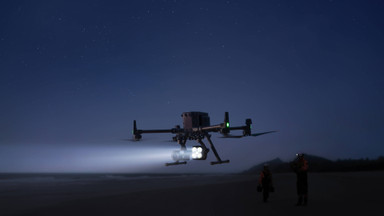
The integration of the Zenmuse S1 spotlight introduces a specialized Laser Excitation Phosphor core designed to pierce absolute darkness with clean, high-intensity visual light.
Technical Projection Values
-
Beam Layout: Advanced laser illumination array throwing a precise 15-degree fixed Field of View directly down an active mission path.
-
Standoff Distance: Maintains exceptional target brightness over a 150-metre projection distance, ensuring complete ground visibility from safe aircraft altitudes.
-
Control Synergy: Complete software synchronization with multi-sensor zoom camera cores via automated flight software to link light tracking with real-time video magnification.
-
Multi-Lighting Flexibility: Instant flight switching between low-beam target identification modes and high-beam wide-area illumination profiles.
2. Pushing Audio Signals Through Dense Environmental Noise
Overcoming Weak Ground Communications
Attempting to transmit life-saving instructions to an injured individual using standard megafones from a riverbank fails completely when plant noise echoes along the valley. Loud environmental sounds like rushing weir water, heavy wind gusts, and local machinery drown out basic commands, leaving victims confused and uncoordinated.
The Zenmuse V1 speaker clears this communication block by providing a high-volume acoustic broadcasting node capable of delivering voice messages over long distances.
+------------------------------------+------------------------------------+
| Tactical Mission Need              | Integrated Payload Response Asset  |
+------------------------------------+------------------------------------+
| Spot Obstacles Under Bridges       | Synced Zoom Tracking Spotlight     |
+------------------------------------+------------------------------------+
| Clear Industrial Machinery Noise   | 114dB Anti-Howling Speaker Output  |
+------------------------------------+------------------------------------+
| Deliver Spontaneous Instructions   | Live Controller Microphone Link    |
+------------------------------------+------------------------------------+
| Execute Recurring Search Paths     | Pre-recorded Loop Storage Memory   |
+------------------------------------+------------------------------------+
Technical Audio Specifications
-
Decibel Delivery: High-output speaker core designed to maintain absolute vocal detail while operating in complex, high-noise industrial or rural areas.
-
Vocal Processing: Integrated hardware anti-howling algorithms that remove feedback distortion, ensuring crisp sentence delivery during live operations.
-
Broadcasting Modes: Real-time audio transmission via the hand-held remote control controller microphone alongside text-to-speech conversion files and stored audio loops.
-
System Integration: Direct software binding with collaborative cloud platforms, enabling remote control rooms to upload audio alerts straight to an active aircraft.
3. Stacking Payloads Into a Single Command Matrix
The most effective emergency response strategy relies on combining these individual tools into a single, coordinated asset group. Mounting the spotlight next to a multi-sensor camera assembly allows tactical teams to manage separate operational tasks at the same time.
Your aircraft can track an active thermal signature from a distance, snap the spotlight beam onto the target coordinates, and use the loudspeaker to deliver clear safety instructions while rescue boats move in. This unified workflow eliminates information gaps and ensures ground teams operate with complete clarity.
4. Operational Oversight and Rapid Compliance Logs
Conducting complex nighttime searches or managing spontaneous disaster responses demands flawless administrative tracking to satisfy strict Civil Aviation Authority guidelines. Every sudden emergency deployment, special low-light authorization, and active equipment asset hour must be fully documented for annual safety audits. Relying on loose paperwork or basic text messages during a fast-moving incident creates compliance gaps and slows down team mobilization.
Central platform managers like
Your logistics team can rapidly check active restriction zones, review automated risk documents, and maintain accurate equipment health records from a centralized dashboard. This digital system cuts down your prep time, simplifies your team reporting, and keeps your search assets ready for immediate call-outs.
Optimize Your Tactical Sensor Fleet
Deploying professional payload hardware means matching your sensor configurations with the extreme conditions your teams face during late-night call-outs. If your organization handles rural rescue missions, emergency incident coordination, or multi-agency security alerts, pairing tactical light columns with clear voice broadcasting systems provides a flexible safety network. Keeping these systems organized removes operational confusion and keeps your teams moving forward.
Take a look at your team's current night response kit and check where low visibility limits your field progress.
Head over to the