
Apr 9, 2026
Why Your 2026 Survey Data is Only as Good as Your Workflow
The "good enough" era of drone mapping is officially over. In 2026, clients aren't impressed by a grainy orthomosaic or a point cloud that "looks about right." They are demanding sub-centimetre precision and high-fidelity 3D assets that can be dropped straight into a BIM environment without a week of manual "cleaning."
Beyond Photogrammetry: The Rise of 3D Gaussian Splatting
Traditional photogrammetry is still the backbone of measurement, but 3D Gaussian Splatting has changed the game for architectural twins. While standard mesh-based reconstruction often struggles with reflective glass, thin railings, or complex scaffolding, Gaussian Splatting treats the scene as a collection of "soft" volumetric shapes.
The result is a visually stunning, photorealistic model that handles the tricky UK light better than any legacy software. If you are presenting an "as-built" model to a stakeholder, the visual clarity of a Splat-based twin wins the contract every time. However, remember the golden rule: use Splatting for the "wow" factor and stick to your RTK-backed photogrammetry for the hard measurements.
Killing the Manual Click: DJI Terra 5.2 Automation
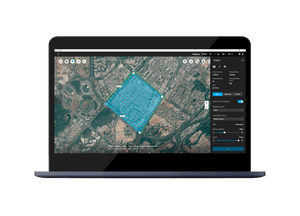
Ground Control Point (GCP) marking used to be the most soul-destroying part of a surveyor's Tuesday. With the release of DJI Terra 5.2, we have finally moved into the era of "Fully Automatic Target Recognition." If you are using standard square or diagonal targets—or better yet, the DJI D-RTK 3—the software now identifies and marks your GCPs during the aerotriangulation phase.
You no longer have to sit there clicking the centre of 50 different targets across 400 photos. You import your coordinates, toggle "Auto GCP," and let the algorithm do the heavy lifting. On a 1,000-image site, this single workflow shift saves roughly three hours of desk time per project.
The ROI of the Unified Stack
Running a fragmented workflow is a silent profit killer. Using one brand of drone, a third-party flight app, and a generic processing engine creates "data friction" where files need constant converting and coordinate systems often clash.
By moving to a unified DJI hardware-software stack, you eliminate these bottlenecks:
-
Native Integration: Terra reads the "High-Efficiency" HEIF files from your Zenmuse L3 or M4E directly, saving 30% on storage.
-
Coordinate Harmony: No more fighting with OSGB 1936 transformations; the software understands the sensor's metadata natively.
-
Speed: The 2026 "Efficiency Mode" in Terra 5.2 slashes reconstruction times by 40% compared to last year's build.
Upgrade Your Data Accuracy
The most successful UK firms aren't the ones with the biggest drones; they are the ones with the smoothest workflows. Pairing the DJI D-RTK 3 Multifunctional Station with DJI Terra ensures your data is as professional as your flying, providing centimetre-level positioning that imports seamlessly into your processing engine.
Integrating your hardware with a robust flight management system is the final piece of the 2026 professional puzzle. Using Dronedesk to plan your missions ensures that every flight is logged against the correct project code, with automatic NOTAM feeds and ground hazard checks keeping you on the right side of the CAA. By syncing your flight logs directly from the field, you can track battery cycles on your Matrice 400 or M4E and monitor pilot currency without touching a single spreadsheet. It turns a fragmented data capture session into a fully audited, enterprise-grade operation that's ready for any site inspection or safety audit.
Ready to eliminate manual marking and speed up your delivery? Explore our