
Mar 17, 2026
Matrice 4E vs Matrice 350 RTK: Choosing Your Next Fleet Workhorse
It is a Tuesday morning on a construction site in the Midlands. The drizzle is steady and the wind is hitting 12 metres per second. If you are flying the new Matrice 4 Series, you are likely checking your screen and pushing through. If you have a Matrice 350 RTK on the pad, you are swapping a payload and cracking on with a LiDAR scan.
With the Mavic 3 Enterprise now discontinued, the Matrice 4 Series has taken over as the primary tool for rapid deployment. But for UK operators, the question remains: when do you stick with the compact M4, and when do you step up to the M350?
Weather Resilience: The IP55 Standard
Both the Matrice 4 and the Matrice 350 RTK now carry an IP55 rating. This is a significant leap for the compact series. In the old Mavic 3E days, a bit of rain meant packing up the van. Now, both platforms are built to survive the standard British summer.
While the ratings are the same, the Matrice 350 is still the more stable bird in high winds. Its larger motors and higher mass mean it doesn't have to work nearly as hard to stay steady during a bridge inspection. If your work is primarily coastal or in high-exposure areas, the M350 still offers a smoother ride for your data.
Sensor Power: Integrated vs Modular
The Matrice 4 Series uses a fixed triple-camera array. You get a 4/3 CMOS wide camera, a telephoto with 112x zoom and (on the 4T) a high-res thermal sensor. It is an incredible all-in-one package for roof surveys, search and rescue or standard mapping.
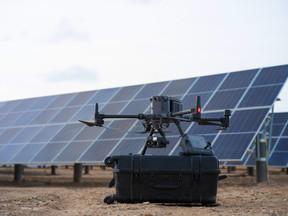
The Matrice 350 RTK is a different beast entirely. It is a modular platform. If a client asks for a survey-grade LiDAR point cloud today and a high-accuracy photogrammetry map tomorrow, you just swap the Zenmuse L2 for a P1. The M4 is a Swiss Army knife; the M350 is the entire toolbox.
The ROI of Battery Cycles
Operational costs come down to how often you replace your flight packs. The Matrice 350 uses TB65 batteries, which are rated for 400 cycles. They are expensive up front, but the cost per flight is remarkably low over two years.
The Matrice 4 uses a new, smaller intelligent battery. While they are significantly cheaper to buy than TB65s, the aircraft typically handles shorter flight times (around 30–35 minutes in real-world UK conditions) compared to the M350’s potential for 55 minutes. If you are mapping hundreds of hectares, the M350 gets you home and home to the family an hour earlier.
Regulatory Shifts: Beyond the GVC
Operating in the UK means keeping pace with the transition to the new Remote Pilot Competence (RPC) framework. While the General Visual Line of Sight Certificate (GVC) has been the standard, the CAA is phasing in the Level 1 Remote Pilot Certificate (RPC-L1) to align with UK SORA requirements.
The Matrice 4 Series sits at a takeoff weight of around 1.2kg. This makes it a lighter lift for risk assessments in your Dronedesk dashboard. The Matrice 350 RTK is a heavy-lifter that often requires more robust planning and higher SAIL levels under the new SORA framework.
Which One Wins?
If your business is built on agility—rapid roof inspections, quick site progress photos and urban mapping—the Matrice 4 Series is your new ROI champion. It replaces the Mavic 3E with better weather proofing and a far superior sensor.
If you are bidding for Tier 1 infrastructure, large-scale survey work or heavy industrial inspections, the Matrice 350 RTK is still the only choice. The ability to run specialised payloads like the Zenmuse H30 or LiDAR is what will win you those high-value contracts.
Still weighing up the numbers on a fleet upgrade? Drop us a line at the shop.