
Mar 17, 2026
Choosing Your Heavy-Lifter: Matrice 350 RTK vs Matrice 400
If you have spent the last few years swapping Zenmuse payloads on a Matrice 300 or 350, you know these machines are the backbone of UK industrial flight. They are reliable, familiar and they just work.
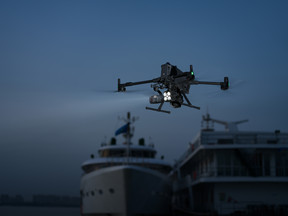
But the arrival of the DJI Matrice 400 has shifted the goalposts. This isn't just a minor iteration; it is a heavy-lift platform that introduces capabilities we have never seen in the enterprise sector before.
Power and Payload: The Heavy-Lift Reality
The Matrice 400 is built for a different scale of work than the Matrice 350. While the M350 is a versatile tool, the M400 is an industrial beast designed for massive payloads and longer endurance.
-
Payload Capacity: The Matrice 400 can carry a maximum payload of 6 kg.
-
Flight Time: Despite the extra weight, it offers a max flight time of 59 minutes when carrying an H30T sensor.
-
The Battery Shift: To achieve this, it uses the new TB100 batteries, which boast a 20254 mAh capacity.
-
Comparison: For context, the Matrice 350 typically stays in the air for 42 to 55 minutes depending on the setup. This makes the M400 a significant step up for large-area mapping or prolonged SAR missions.
Next-Gen Sensing and Safety
Safety on-site is your primary concern, and the Matrice 400 introduces a belt and braces approach to sensing. While the M350 relies on standard vision and infrared sensors, the M400 integrates active scanning technologies to handle complex environments.
-
Active Scanning: The M400 features a rotating LiDAR system with a 360° horizontal field of view.
-
Radar Protection: It includes a six-direction mmWave radar for advanced obstacle detection.
-
Obstacle Range: The detection range for obstacles like power lines extends up to 200 metres.
-
Night Operations: The FPV camera is starlight grade, offering significantly better visibility for 24/7 operations.
Transmission and Signal Reliability
In the UK, signal interference in urban or industrial environments can be a nightmare. The Matrice 400 uses the O4 Enterprise Enhanced system, which is a full generation ahead of the M350.
-
Max Range: The M400 offers a theoretical max transmission distance of 40 km under FCC standards or 20 km in CE regions.
-
Antenna Array: It utilises an 8-antenna system to maintain a stable link in congested RF environments.
-
Remote Control: It ships with the DJI RC Plus 2, featuring a 7.02-inch screen and 1400 nits of brightness for clear viewing even in direct sunlight.
Operational ROI: Which One Fits Your Fleet?
Choosing between these two comes down to your specific contract requirements. The Matrice 400 is the clear choice for:
-
BVLOS and Long-Range Ops: With 40 km range and O4 transmission, it is built for the future of UK drone corridors.
-
Complex Inspections: The ability to carry 6 kg means you can fly multiple sensors or specialised third-party equipment simultaneously.
-
Extreme Reliability: The IP55 rating and active LiDAR sensing make it the safest bet for high-value asset inspections.
The Matrice 350 RTK remains a solid choice for:
-
Established Fleets: If you already have a large stock of TB65 batteries and Zenmuse H20 or P1 payloads, the M350 is a cost-effective way to maintain your current workflow.
-
Standard Surveys: For 2D mapping and standard 3D modelling where 45 minutes of flight is more than enough.
Compliance Made Easy
Whether you choose the M350 or the M400, your biggest headache is the admin. The Matrice 400, with its increased weight and complex battery station, requires meticulous logging to stay on the right side of the CAA.
Dronedesk simplifies this by helping you track your flight logs and battery health checks. As you move into the heavier weight classes of the M400, having your risk assessments and maintenance schedules organised in Dronedesk is the best way to ensure your Operational Authorisation stays valid.
If you need a platform that can handle the unpredictable UK elements while delivering survey-grade data, check out our full range of